
Wachhaus #03: Hannah Linden
Heimat
Opening on July 2, 4 pm
Mon–Sun 10 am–6 pm
In April 2023, the Stiftung Insel Hombroich started a cooperation with the Kunstakademie Düsseldorf. Within this framework, students of the academy are invited every two months to realise a work in the guardhouse of Raketenstation Hombroich. The third exhibition will be held on 2 July by Hannah Linden. She has been studying at the Kunstakademie in Sabrina Fritsch’s class since 2020.
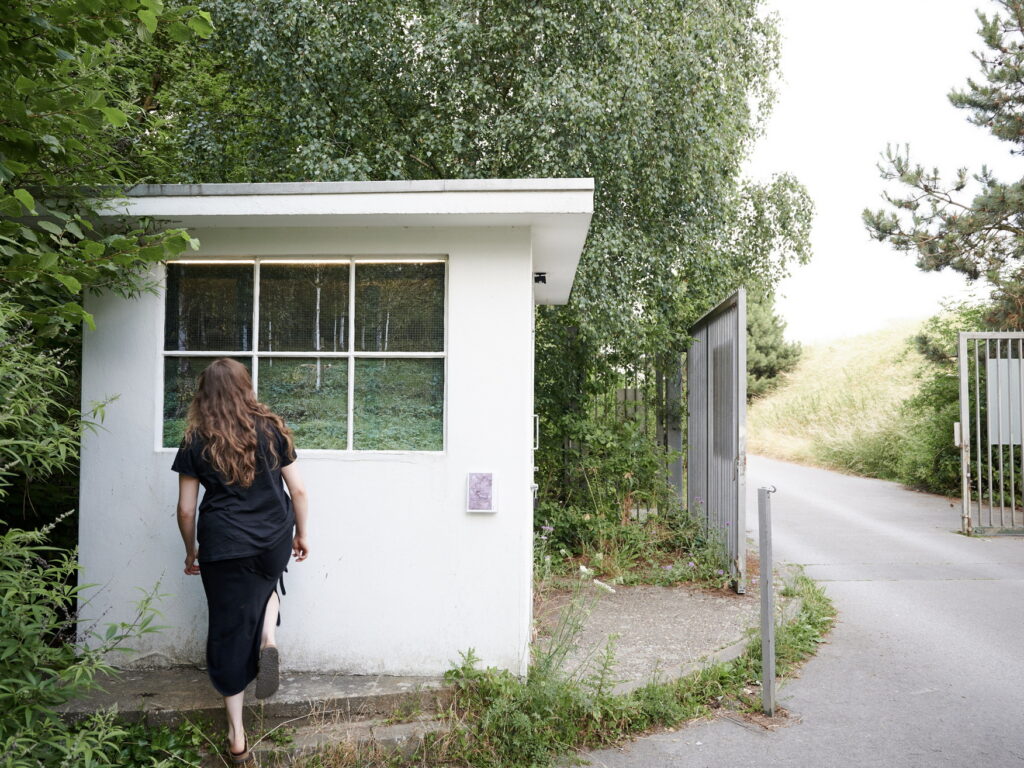
The function of the Wachhaus is observation. Therefore, seeing is thematically at the centre of this installation. The Wachhaus can be seen as a medium, a kind of magic lantern, with which visual perception can be sharpened. Looking inwards and outwards should be equally part of this work.
When one approaches the guardhouse, the lighting is switched on by a motion detector. Thus, the viewers who want to look inside become aware of their voyeuristic curiosity. The interior remains hidden from view. Photographs with motifs of the Rhein region can be seen behind the five windows, which are illuminated from the inside.
The relationship of seeing and being seen contains a power imbalance that is to be reflected through the reversal of expectation.
Hannah Linden looks at the guardhouse of the rocket station as an installation object. In the photographs she shows — all of which were taken in the Rhineland region — she takes a critical look at the concept of “home” and how we deal with the past. How does the longing for the lost homeland collide with the reality of consumer society?
To this end, Hannah Linden shows interiors of an inn that have been conserved in the LVR Open Air Museum Lindlar. She asks about the romantic subject of the forest, in which security and danger enter into an uncanny alliance. However, the forest in question is also staged nature, since it is an artificial plantation. She confronts the myth of blood and soil with a revealing frontal view that shows the earth for what it is: amorphous matter that neither belongs to anyone nor has mythological significance. The fact that the past is being destroyed in real terms to meet the future energy needs of a consumer society can be observed in the immediate vicinity of the rocket station to which the final image of the installation is dedicated.